
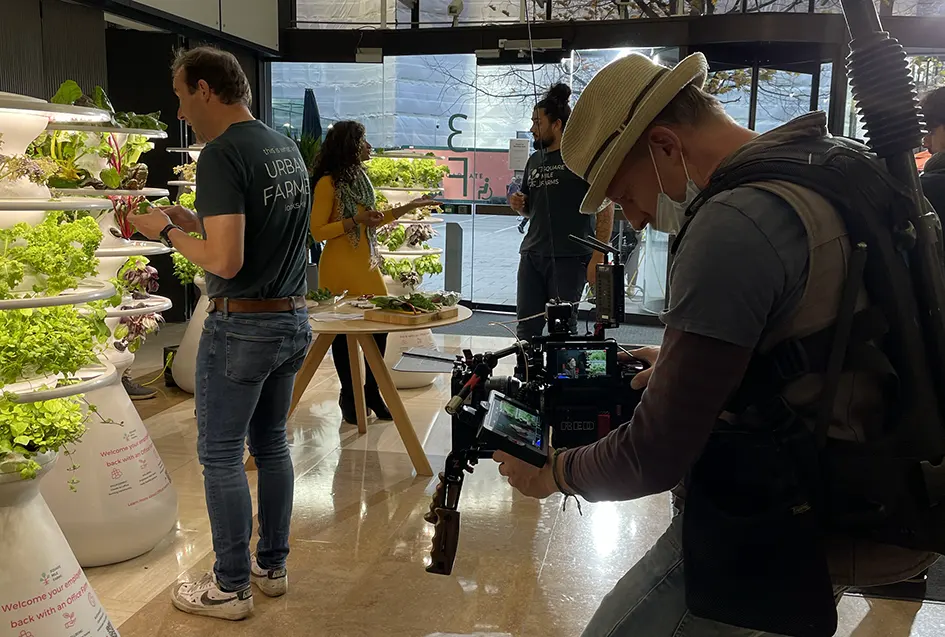
Corporate video production in London covers executive interviews, launch films, internal communications and case-study films. What separates the work that lands from the work that gets skipped is not budget but treatment: the films that hold attention are directed, not assembled. This guide sets out the formats that earn attention in London and how to choose a production partner.
The phrase “corporate video” carries a certain weight of expectation, and most of it is unflattering. Fluorescent boardrooms. A logo animation that overstays its welcome. A voiceover reciting values no one in the room believes. For years this was the accepted grammar of the form, and audiences learned to look away the moment it began. The best work being made in London today is a deliberate argument against that grammar — a case that a company’s story deserves the same craft as a commercial or a feature.
This guide is for the marketing director, the founder, the head of communications weighing up their next film. It sets out what corporate video production in London actually involves when it is done seriously, why the city has become such fertile ground for it, and how to tell the difference between a supplier who fills a brief and a production partner who elevates it.
Why London
London is one of the few cities in the world where advertising, television, and cinema share the same talent pool. A director grading a brand film in Soho this week may have shot a national commercial the month before and a short with festival ambitions the month before that. That cross-pollination matters, because the disciplines borrow from one another constantly. The lighting instincts of a drama, the pacing of a commercial, the restraint of a documentary — corporate work benefits from all of it.
The city’s infrastructure compounds the advantage. World-class camera crews, colourists, sound designers, and post houses sit within a short distance of one another, and the location range within a single day’s drive is extraordinary: trading floors, laboratories, warehouses, Georgian townhouses, coastline. A London production can look like anything, because London can be photographed as almost anywhere.
The formats that actually earn attention
Corporate video is not one thing. It is a family of formats, each with its own logic, and the mistake most often made is treating them as interchangeable.
Executive interviews are deceptively hard. A chief executive who is fluent on a stage can freeze the moment a lens appears. The craft lies in the room before a single frame is captured — in how the space is lit, how the questions are framed, how the subject is put at ease so that conviction reads as conviction rather than recital. When it works, an interview film does something no press release can: it lets people decide they trust the person speaking.
Launch films ask for the vocabulary of advertising. A product, a platform, a rebrand — these are moments that need to feel like arrivals, and that means treating the launch with cinematic ambition: a considered edit, an original score, a sense of build. Investor communications pull in the opposite direction, prizing clarity and composure over spectacle, though never at the cost of looking like the company means it.
Internal communications and employer branding are where the corporate film has quietly become most interesting. The audience here is unusually discerning — your own people know precisely when they are being sold a version of the company they do not recognise. Honesty, photographed well, is the only thing that survives that scrutiny. The strongest recruitment films look less like adverts and more like short documentaries, because that is what earns belief.
Cinematic corporate storytelling
The organising idea behind all of this is simple to say and difficult to execute: a company film should be built the way a film is built. That means a point of view, not just a shot list. It means the discipline to cut the line the client loves but the audience will not miss. It means understanding that emotion, not information, is what makes a message stay.
At Beast Films, this is the through-line across every discipline. The company was founded by filmmakers Lawrence Jacomelli and Victoria Taylor, and its work has been recognised at Cannes Lions — a body of craft assembled across commercials, branded content, and independent cinema. Corporate briefs are approached with the same instincts that shape that other work, because a boardroom and a soundstage are more alike than they appear: both are rooms where a story either lands or it doesn’t.
How to choose a production partner
Read the showreel, but read it critically. Anyone can assemble handsome drone footage and a swelling track. Look instead for evidence of thinking: does the work say something, or merely look expensive? Ask who will actually direct your film, and whether that person will be in the room on the day. Ask how they handle a nervous subject, a compressed schedule, a message that keeps changing. The answers reveal experience faster than any list of credits.
Budget deserves an honest conversation early. A serious production partner will tell you where money makes a visible difference and where it does not, rather than inflating every line. And they will talk about outcomes — what the film is for, who it needs to move, what it should make them do — long before they talk about kit.
Corporate video in London has quietly outgrown its reputation. The companies making the strongest work have stopped thinking of these films as an obligation and started treating them as an opportunity to be seen clearly. If you are ready to make something in that register, explore Beast Films’ approach to corporate video production — and begin the conversation with the story, not the spec.