How Long Does Video Production Take? A Realistic Timeline
It is the first question almost every brand and agency asks, and the honest answer is the one nobody wants to hear first: it depends. A single-location interview film and a cinematic brand campaign with a director, a crew and a build-out live in completely different worlds. But “it depends” is not an excuse to be vague. Behind every schedule sits a logic, and once you understand how a production actually moves — from a rough idea to a finished, graded film — you can plan with real confidence rather than crossed fingers.
So how long does video production take? Rather than quote a number that would be wrong the moment the brief changed, it is more useful to walk the four stages every serious film passes through. Each has its own rhythm, its own pressures, and its own way of quietly expanding when it is rushed.
Development: the stage that decides everything else
Development is where the film is really made — long before a camera is switched on. This is the conversation about intent: what the film needs to do, who it speaks to, and what it should make an audience feel. A treatment takes shape, references are gathered, and the creative idea is pressure-tested against the commercial goal behind it.
It is tempting to compress this stage, because on paper nothing is being “produced.” In practice, the projects that overrun in post are almost always the ones that skipped a proper conversation at the start. Time spent here is not delay; it is insurance. A clear, agreed direction is the single biggest factor in how smoothly everything downstream runs. At Beast Films, this is the stage founders Lawrence Jacomelli and Victoria Taylor treat as non-negotiable — the difference between a film that merely gets made and one that lands.
Pre-production: turning an idea into a plan
Pre-production is where the abstract becomes concrete. Locations are scouted and secured. Casting is confirmed. A director of photography is brought on, a shot list is built, and the shoot is designed hour by hour. Permits, insurance, crew, equipment, wardrobe, art department — the invisible architecture of a shoot day is assembled here.
The length of this stage scales with ambition. A film that lives in one controlled space with a small cast can be prepped quickly. A campaign with multiple locations, talent negotiations, weather dependencies or a bespoke set will need considerably more runway. This is also where scheduling collides with reality: a specific director, a particular location, or a named cast member may simply not be available on the date you had in mind, and the calendar bends around them. Good producers protect this stage fiercely, because a well-prepared shoot is a calm one — and a calm one is a fast one.
The shoot: the shortest, most expensive days
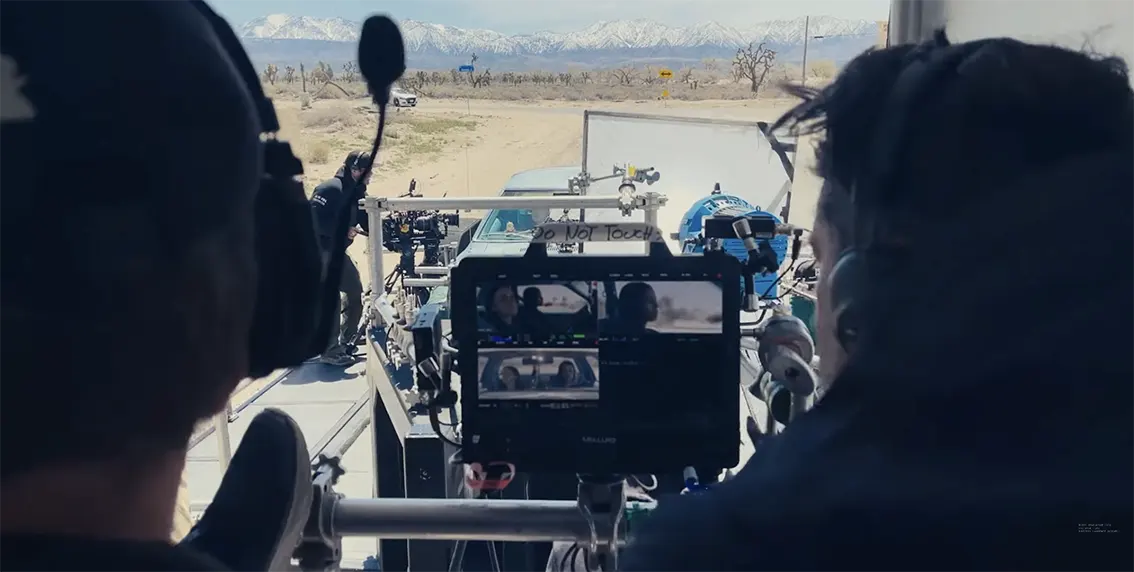
Principal photography is, counter-intuitively, often the briefest phase of the whole process. Many commercials and brand films are captured in a single day; larger productions run across several. Yet these are the most resource-heavy hours in the entire timeline — a full crew, cast, equipment and locations all converging at once.
That concentration is exactly why the preparation matters. Every decision deferred from pre-production reappears on set, where it costs the most to solve. When a shoot feels effortless, it is because the hard thinking happened weeks earlier. This is the discipline behind serious commercial production: the day itself is the payoff for everything that came before it, not the place where the film gets figured out.
Post-production: where the film is found
Post is frequently the most underestimated stage — and often the longest. The edit is where structure, pace and emotion are shaped from the raw footage. Then come the layers that separate a competent video from a cinematic one: colour grade, sound design, music, mix, motion graphics and titles. Each pass is followed by review, feedback and refinement.
Timelines here depend heavily on complexity and on how many rounds of revision a project carries. A clean edit with a tight approval process moves briskly. Heavy visual effects, original scoring, multiple stakeholders or several deliverable versions — different cut-downs, aspect ratios and language edits — all extend the runway. It is worth building in room for this rather than treating post as an afterthought, because it is the stage where the film’s final quality is genuinely decided.
Planning with realism, not optimism
The most useful way to think about a video timeline is to work backwards from the deadline that actually matters — a launch, an event, a campaign go-live — and to protect development and post at both ends, since those are the stages most often squeezed and most damaging when they are. Commercial experience, the kind honed on award-winning work, is largely the ability to see where a schedule will strain before it does.
There is no universal number, and any production company that offers one before understanding your brief is guessing. What a good partner can offer is a realistic, stage-by-stage plan built around your specific film — one that respects the deadline without quietly sacrificing the craft that made the film worth commissioning in the first place.