The Video Production Process, Explained: From Brief to Delivery
Every finished film hides its own making. On screen there is only the result: a held look, a landscape that lands at the right beat, a line of voiceover that seems inevitable. Behind it sits a sequence of decisions, most of them made long before a camera turns over. Understanding the video production process is really about understanding those decisions, and the order in which they have to be made, so that nothing is left to chance and everything on screen feels considered.
The process is usually described in three acts, pre-production, production and post-production, bracketed by a brief at the start and a delivery at the end. Those labels are accurate but a little bloodless. What follows is the same journey told the way filmmakers experience it, as a chain of craft rather than a checklist.
The brief: deciding what the film is for
Nothing useful happens until the brief is honest. A brief is not a shot list or a mood board; it is a statement of intent. What should a viewer feel, believe or do by the final frame? Who are they, and where will they meet the film, a broadcast break, a boardroom, a festival screening, a phone held at arm’s length on a train? A thirty-second television commercial and a founder’s investor film may share a budget line, but they are different animals, and the brief is where that difference is named.
This is also where strategy and craft first meet. A good production partner will push on the brief before agreeing to it, testing the idea for where it is strong and where it is only decorative. The point is not to complicate the ambition but to protect it. Every later decision, from lens choice to edit rhythm, inherits its logic from this stage.
Pre-production: where the film is really made
Filmmakers have a quiet saying: the film is made in pre-production, then rescued or ruined on the day. Pre-production is the long, unglamorous stretch where a concept becomes a plan detailed enough to survive contact with reality.
It covers a great deal at once. Treatment and script give the idea a spine. Directors, cinematographers and producers translate that spine into a visual grammar, aspect ratio, colour language, the difference between a locked-off frame and a restless handheld one. Casting decides who the audience will trust. Location scouting, permits, scheduling and budgeting turn intention into logistics. A shot list and, for choreographed work, a storyboard map what has to be captured and in what order.
The craft here is anticipation. Weather, light, a location that photographs nothing like it looked in the recce, an actor’s availability collapsing to a single afternoon, these are not surprises to a seasoned team; they are contingencies already planned around. Good pre-production buys freedom on set, because the questions that would otherwise stall a shoot have already been answered.
Production: the shoot
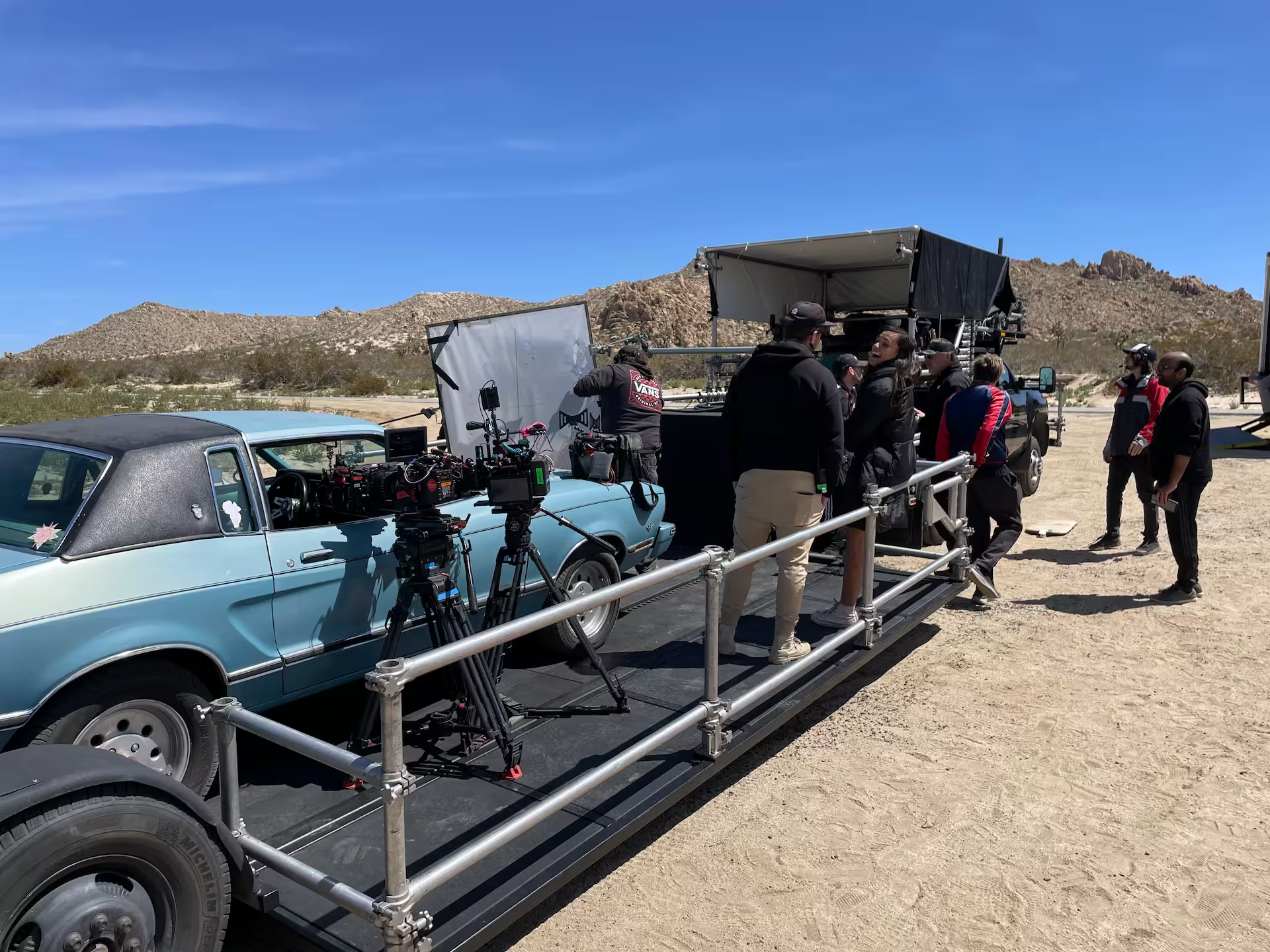
The shoot is the most visible stage and, paradoxically, often the shortest. A commercial that lives on air for a season might be captured in a day or two. Those hours are dense. A crew moves through the schedule while the director watches for the thing a plan cannot guarantee, the performance that is true, the accident of light that is better than anything storyboarded.
Discipline is what makes room for that kind of instinct. Because the framing, blocking and coverage were decided in advance, the set can afford to chase a better take when one appears. This is the mark of an experienced London video production company: the ability to run a tight day and still leave space for the unrepeatable moment. Data is backed up as it is captured, continuity is watched, and every setup is checked against what the edit will need, because the shoot exists to serve the cut, not the other way round.
Post-production: finding the film in the footage
Post-production is where the material becomes a film. The edit is the first and most decisive craft, the assembly that finds structure, then the fine cut that finds rhythm. A single scene can be tender or tense depending on where a cut falls and how long a look is allowed to hold.
Around the edit sits a family of finishing crafts. Colour grading gives the film its emotional temperature. Sound design and mix build a world the picture only implies, room tone, footsteps, the low presence that makes an image feel physical. Music, whether scored or licensed, carries meaning that dialogue cannot. Motion graphics, titling and visual effects add clarity or spectacle where the story calls for them. Each pass is reviewed, noted and refined, often across several rounds, until the film matches the intent set out in the brief. In corporate and brand work in particular, this is where restraint earns its keep; the discipline behind considered corporate video production is knowing what to leave out so the message lands cleanly.
Delivery: the last, exacting mile
Delivery sounds administrative and is anything but. A broadcaster, a cinema, a social platform and an internal player each demand different specifications, codec, resolution, frame rate, colour space, loudness standard, subtitle and caption files. A film that is beautiful but technically non-compliant does not air. This final stage protects everything upstream of it, mastering the film correctly and packaging it for every destination it will travel to.
Craft, not conveyor belt
Laid out in sequence, the process can read like a production line. In practice it is closer to a single unbroken argument about what the film is trying to say. Beast Films, founded in London by Lawrence Jacomelli and Victoria Taylor and recognised at Cannes Lions, treats the video production process not as a series of hand-offs but as one continuous act of authorship, from the first honest brief to the final delivered master.