Author: beast

rtert
From The Blog

VIDEO CONTENT MARKETING – QUESTIONNAIRE


No Comments

VIDEO CONTENT MARKETING   Planning for video content can be a daunting task. And if you’re new to video content production and marketing, you may not know where to start. When we work with clients to build content marketing strategies, the first thing we do is walk them through our content questionnaire. Using this content tool is a way for our team to get familiarized with our clients and their business goals. A content questionnaire is also a great tool for clients to understand how their business goals can be supported through the use of content marketing as a way to spread their brand’s message, (and sometimes, opens their eyes to repair the “holes” that are missing before pushing forward). Whether you manage your online content strategies in house or hire out, there are a few essential pieces of information you’ll want to gather before digging in to your video content strategy. 1. What do you characterize as your main attributes? 2. What is the main service or product that your client needs the most? 3. How do individuals feel after they utilize your product/service? (Do you have the details to back this up?) 4. What faults do your clients tell you about? What have you heard that they need improvement with? 5. What are your clients attempting to achieve by utilizing your product/services? 6. What is your USP? What separates you from your peers? 7. Who is your opposition (everybody has a competitor–do not skirt this inquiry!) 8. Depict your run of the mill client. Are your current customers the same as your target market? (In other words, are you reaching the types of customers you are trying to reach?) 9. What is your key target market? (Once more, this is an essential inquiry not to skip. Do not reply “everybody,” be precise) 10. What does your sales or lead marketing process look like? How do customers find you? 11. Do you have a set brand voice? Slogan? What sentiments would you say you are attempting to stimulate? 12. In the event that you were looking for your products/services on the web, what key search terms would you utilize? What might your clients use? 13. How compelling are your present promoting platforms? How far is your reach? 14. Do you have the capabilities to provide consistent, ongoing content? What resources do you have currently (and what might you need to add?)

Read More

From The Blog

Popular Youtube Personalities


No Comments

If you were certain that the most popular  Youtube personalities would be singers and TV hosts like Justin Bieber and Ellen, you’d be wrong. The most subscribed YouTube account is actually one by the name of PewDiePie, which features Swedish twenty-six year old Felix Kjiellberg – an individual you’ve presumably never heard of, even though statistically every human on Earth has watched at least two of his content videos. This insane popularity pushed him to an astounding $12 million net worth. He reached this fame and fortune by humorously commentating video games – which makes him a perfect example of a youtuber. A youtuber, or vlogger (from video blogger), is a person who gathered a significant fanbase by regularly uploading original video content of any kind onto YouTube. Several creators managed to gain an audience so big that it prompted the site to share its revenue with them. However, vloggers haven’t stopped there, monetizing their success in every way possible – from ads and sponsorships to books and TV shows. Money off videos YouTube pays its creators by giving them a fraction of the money  a company pays to have their brands advertised with creative video content. This works with the help of a program named AdSense. It lets the user choose the position and type of ads, while deciding the highest paying commercials for the type of video. It then pays the youtuber’s channel with a certain amount of money per thousand views – this amount is set according to how easy it is to reach your audience; the more niche your channel, the more appreciated will the your views be. There are also other ways to increase your revenue – the most obnoxious types of ads pay much better than quiet, embedded ones next to your video. If you can afford losing potential audience, a thirty second long commercial you cannot skip is the highest earning choice. Youtubers can also use sponsorships as a way to earn money. The brands that have figured out the profitability of these sponsor deals are so few that they have taken complete charge over the market. Thus, every YouTube viewer will have heard of Audible, NatureBox, CrunchyRoll, and other similar sites because of the discount codes that vloggers keep giving out. Beauty channels, which already mention makeup products they like, are being sent so many free samples that they have the liberty to promote the ones they actually enjoy using, so as to not ruin the reliability of the opinions they share. Also, YouTube titles and thumbnails are required to have an indication that the certain video is sponsored, so that the channels cannot outright lie to their viewers. If a creator wants to post and monetize their videos without worrying, they can always hire a manager or work with a multi-channel network (MCN). These are companies that offer assistance in a number of areas, including promoting, audience development, and digital rights management. Gleam Futures, for example, is an MCN that works with a web of British youtubers, promising to “develop, monetize, and protect”. However, such a network can take away from the vlogger’s liberty over their channel. This has lead to multiple scenarios – in one, like the “Gleam Team”, the videos of the different youtubers grow so similar that they become devoid of any individuality. In other situations, however, the outcome is more drastic; for example, American vlogger Grace Helbig had to start a whole new channel because of a row with her MCN, “My Damn Channel”. She left her old platform, “dailygrace”, on which she had acquired over a million subscribers, in the hands of her former managers – who began posting reruns of her videos (a first for YouTube, which is a website, not a TV station, thus rendering reruns completely unnecessary) and have now turned it into a collaboration channel. However, this scandal was definitely not unfounded; apparently, multi-channel networks are so infamous that YouTube itself warns you before you affiliate with any of them. Creating a successful YouTube channel Because of the changes made by Google over the years, the site brings a significant advantage to users who already have an audience. So potentially revolutionary video creators can be lost in the company of a sea of meaningless video content. As such the key is simple – hard work and patience. There’s no magical shortcut to years of determination and weekly content. There are, though, certain formulae to optimize the presence of your videos in the search results. For example, doing popular challenges or tags that successful channels have done is a great way for their viewers to find you. However, you need to make sure you bring something new or entertaining to the challenges, because they can be as dumb as chugging a gallon of milk or guessing the body part your partner is shoving in your face. The trend that started the whole “tag craze” was the Cinnamon Challenge, which demonstrated to the whole YouTube community the dangers of eating a spoonful of the condiment. Since then, tags have based themselves on trends such as current technology, like the Macbook’s Photobooth effects or the Faceswap app. For beauty vloggers, makeup-themed popular challenges would be videos with titles such as “Five Minute Makeup Tag”, “No-Mirror Challenge” or “Boyfriend Does My Makeup”. These tags have become so popular that more creative youtubers have taken to transforming them into something new, such as filmmaker KickThePJ’s surrealist “What’s In My Bag” challenge (seriously, look it up). Along with that, a great way to increase your audience is collaborations with other creators. Since the YouTube community is very tightly knit, collabs are by far the easiest and most enjoyable videos to film. This is why youtubers tend to group around in cities like Los Angeles, London and Brighton, even living together to make work easier. Tyler Oakley, a popular American vlogger, even does a yearly series of daily collaborations that he calls “Auguest”, labeling each with a cheesy portmanteau of his

Read More

From The Blog

Becks – CapCam


No Comments

There seems to be no limit to the creativity and fun people are having with video these days. Becks have now married two of our favourite things! Beer and Video. As they explain to us, life doesn’t happen in tunnel vision, it happens all around us. This cool little bit of tech just sits onto your iPhone camera so you can film 360. http://www.thedrum.com/news/2016/06/12/ad-day-becks-capcam  

Read More

From The Blog

Future of Content Marketing


No Comments

future of content marketing – With online video quickly becoming a key means for people to satisfy their information and entertainment needs, small businesses that fail to include video content production in their internet marketing strategies will do so at their peril. If it’s not already, video is the future of content marketing. There’s much research that shows more than half of companies are already making use of the medium – a figure that’s predicted to rise as more and more realize the potential. It is said that 64% or marketers expect video content to dominate their strategies in the near future. It’s easy to see how and why. Video is unrivaled when it comes to prospective reach. YouTube receives more than one billion unique visitors every month – that’s more than any other channel, apart from Facebook.  Well-produced video content can give you a ticket to the party. What other form of marketing can do that? The success stories of videos that have gone viral are vast and now legendary. A recent campaign from Volkswagen, for example, saw a trio of its videos viewed a combined 155 million times. In the event that such numbers appear to be out of compass for organizations without 12-figure income streams, they at any rate show video’s intrinsic shareability. Connect with your viewers and they will tell their friends and there in lies the secret and the power of successful video content. The spider web effect. They will spend longer on your site and additional time immersed with your brand. For any online networking effort, any SEO exercise, video is without uncertainty one of the best ways to grab people’s attention and then keep it. It can be wholly captivating and, during a time of data over-load, it’s essential for small companies to offer substance that is anything but difficult to process; if not, consumers will just proceed onward. It’s no wonder then that Axonn Research found seven in 10 people view brands in a more positive light after watching interesting video content from them. But is video really possible for small businesses? Absolutely. Production costs have fallen significantly in recent years and you no longer need to have a large crew of people to create TV standard video production. Apps such as Twitter’s Vine, with its six-second maximum clip length, have dramatically increased the opportunity for companies on a limited budget to have their say and get their story out there. Of course, if you’re to gain a viable return on your investment, you will need to keep the following in mind: Always consider the audience you are trying to reach and ensure the video is relevant to them. If it’s not the most appropriate means of getting your message across, you are probably wasting your time. Do not disregard social media and be sure to broadcast across multiple channels. If you want to get the most out of your video content’s potential, you must make it easy for users to find and share it. Don’t forget about mobile either. It is said that a tenth of all videos played happens on smartphones and tablets, and it’s an increasingly important sector, with mobile phones holding 41% more share of video consumption at the end of June 2013 than at the start of that year. Finally, be creative, not only with the videos themselves but also in the campaign strategy you build around them. Creativity wins over the cost of production every time. Get that bit right and video won’t just be the future of content marketing; it’ll be the future of content marketing for you.  

Read More

From The Blog

Trends That Are Shaping Video Content


No Comments

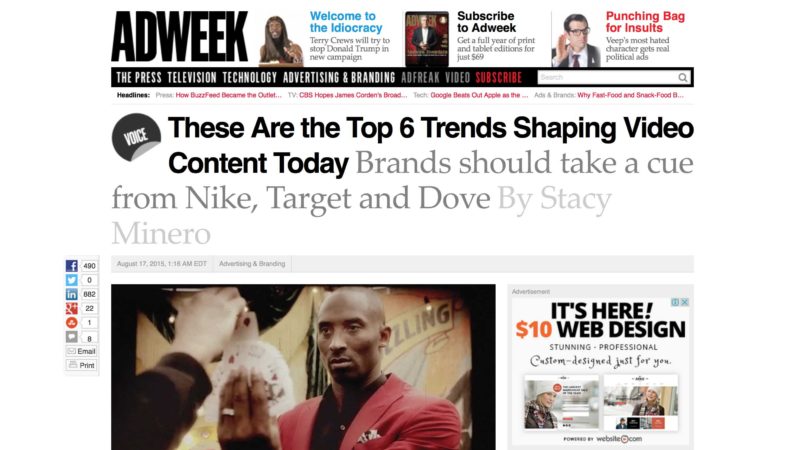
Whats new in marketing and what are the video content trends this year? Here’s an interesting article from Adweek about the main video content trend which are shaping video content production. With the old TV format of 30 seconds firmly set in the past, web marketing with no time restrictions at all offers us all manner of new storytelling possibilities. From high octane and excitement without the safety belt to content with a cause with campaigns like Always’ #LikeAGirl.   http://www.adweek.com/news/advertising-branding/these-are-top-6-trends-shaping-video-content-today-166391

Read More

From The Blog

COLOUR PALETTE


No Comments

See How Colours Set The Mood Of A Film Colour palette in film sets the tone and mood before any of the actors have even uttered a word. Directors Lilly and Lana Wachowski used a green tint in The Matrix (1999) to create a mood palette that was suggestive of the early monochrome computer monitors. Yellow was used in Kill Bill (2003) to depict Uma Thurman’s character’s madness and instability. Romantic comedies use pastel shades like beige, pink and lilac. Sci-fi and cyborg films use shades of blue, grey and green. Teal and orange seem to be the trend in Hollywood nowadays, especially in movie adaptations of graphic novels and comic books.

Read More

From The Blog

5 Reasons Why Your Business Should Use Video Content


No Comments

Why Your Business Should Use Video Content Video content is no longer the dark art it once was. Today’s technology has made video content creation possible and easily attainable. This offers everything from SEO advantages right through to increased sales conversion and brand loyalty. Here is 5 Reason for Why Your Business Should Use Video Content SEO – Pure and Simple The dominance of social media as a marketing tool is growing exponentially. No business can stick to age-old marketing methods, lest it wants to lose valuable customers to other businesses that are adapting. The major search engines now give a lot of value to video content. If your website or business has a video and an article about the same keyword, chances are that your video will rank higher every time. Videos have other benefits too since they usually guarantee accessibility and user retention. Visitors are more likely to watch a quick 2 minute video demonstration of your services than they are to read a long wall of text. In addition, you can target several long-tail keywords with videos to scale your rankings even further. Easier Distribution Mechanisms There are several video distribution sites that allow users to upload their videos to many websites at once. Add your videos to a lot of the popular video-sharing sites such as YouTube, DailyMotion, Vimeo, Imeem and others simultaneously. These websites usually offer optimized videos for their mobile platforms too, thus automatically expanding the reach of the uploader’s brand. The Social Media Effect Since popular social networking sites such as Facebook and Twitter allow users to share interesting links, having your own video on the major sites drastically increases your chances of exposure. Also, people are more likely to share an interesting video they came across rather than an article. Automatically Increase the Magnetism of Your Website If you have been surfing the web long enough, inevitably you have visited a Web 2.0 property, which features a video on the homepage. Having this kind of a setup increases the visitor retention on the page. People are more likely to be intrigued by the service and might stay around to find out more if they are presented with an entertaining video explaining the purpose of the website or the service. Increase Sales By Alleviating Doubts For example, assume the case of a website that reviews cameras and includes the webmaster’s affiliate links at the end of each review. Now for a physical product such as a camera, a video review can show things to the visitor that simply cannot be conveyed effectively through text. In these cases, a video is a far more effective tool to increase the chance of conversions, and subsequently helping the webmaster make money online.

Read More

From The Blog

Brighton Housing Trust – Making of


No Comments

Beast was approached by Fugu PR to help them create a Christmas Video for their client the Brighton Housing Trust. Brighton Housing Trust Video Brief The brief was simple. They wanted to generate awareness, and donations over the Christmas Period, so they could keep their ‘first base’ project open for the coming year. To do this that had to raise £20’000. With only two weeks to come up with the creative and deliver the final video, we took 24 hours to come up with an idea that centred around a Christmas Advent Calendar. The Brighton Housing Trust Video gave us some case studies as part of the research to help us with the development of the script. What stood out to us, was the amount of stories that centred around very normal people and families. What was heartbreaking, was the unfortunate chain of events and speed at which these families became homeless. Many people just lost control of their finances because of a job loss, or unexpected bill. We wanted to highlight how quickly any of us could be in the same position in such a short amount of time. The advent calendar was the perfect vehicle to show this.  Not only was it a great way for us to show the imminent future, but it also helped us to convey the vulnerability of the children, through a Christmas theme. Our story centre’s around a family heading into the advent period. The catalyst for their downward spiral comes from the dad finding out he has lost his job. The calendar then reveals in a succession of days that they have missed other payments, including their rent. With credit cards already maxed out, in three weeks, they have no choice but to have to leave their rented family home. The video was a great opportunity for us to work with an extremely worthy local charity. Jo Berry bent over backwards to help us bring the film to life in such a short amount of time. Here is what she said about the project: “ We were interested in getting a short film produced to support our Christmas fundraising appeal, but had no budget and very little time (around two weeks in order to be ready to go out early December).  Over the course of a week Beast had taken on board the message BHT wanted to convey, understood the charities ethos, explored the different audiences to appeal to and developed the creative. By the end of the second week the storyboard had been finalised and agreed, the locations and props sourced and the actors for the cast secured.  The filming took place over one day and the end result was amazing; a thought-provoking, beautifully shot short film which sensitively captured a family’s experience of becoming homeless. The film generated huge interest and helped BHT to reach its £20k fundraising target and raise the awareness of the issue of homelessness. We are extremely thankful to Beast for their generosity, their creativity and their professionalism.” Beast are over the moon that the Charity reached its target. Brighton Housing trust provides a fantastic ‘First Base’ for people to go to. They provide emotional support, qualified advisors, food and a hot shower to help people get back on their feet. Our campaign title  #WhoWouldYouTurnTo has become the catalyst for an additional social media campaign that we have developed with Fugu PR that will run in the new year. Watch this space.

Read More

From The Blog

The Youtube Phenomenon


No Comments

Youtube Phenomenon – Youtubers have rarely started creating video content with the intention of getting popular. Even the most famous vloggers have created their accounts out of boredom. The Youtube community was born in 2005-2007, when people like Shane Dawson, AmazingPhil and CharlieIsSoCoolLike joined the platform. At the time, the algorithm of the site was different, as was the size of the platform. Therefore, new Youtubers were regularly featured on the homepage, and a tight-knit community was formed. People started making videos just to enter the community and make friends, or in order to promote their music. People kept joining Youtube throughout the years, until 2012- that year, the number of viewers exploded, and people joining in afterwards are mostly lost in the depths of the new Youtube algorithm. Their videos are very different from those who were already established in 2012, as well – Youtubers got a lot more professional at that point, and you can tell the popularity of a Youtuber just judging by the quality of their image and sound. There are many types of videos on Youtube, and not all video content creators can be given the label of “Youtubers”. It’s not necessarily whether they share their face or not (gamers like Cry and animators like Domics purposefully keep their face a mystery for different reasons). However, a Youtuber needs to be personally talking to their viewers and share their opinions in order to be considered one. Within those guidelines, videos can be really diverse. The biggest type of content is definitely gaming – Pewdipie, the world’s most subscribed channel, has gained over 40 million subscribers by making jokes while playing popular video games. Another popular category is beauty – though not the most subscribed channels, makeup and hairstyle tutorials accumulate millions of views from people who watch them for reference. Zoella, a British beauty vlogger, has almost 10 million subscribers. She stands out from the crowd because of her funny collaborations with her brother, boyfriend, and her other friends in the Youtube community, who are mostly humour vloggers. Humour is a very wide category in itself – from well produced skits (like Smosh, who are also known for their childish humour and young audience) to videos about life situations filmed from the person’s own bedroom (like aforementioned AmazingPhil), it contains anything not already defined. Entertainment vloggers are also the most stereotypical Youtubers – they just talk about things, and that’s essentially what the platform is about. Now, Youtube is a new media platform, and many of its video content creators extend to traditional media, either by themselves or because of offers from platforms who understand how big of a deal Youtube is becoming. An example is Grace’s Show – a TV show on E! featuring Youtuber Grace Helbig, who is famous for her awkward, ironic personality. The show is peppered with clichés and tacky editing, clearly added to ‘appeal to teenagers” by E!’s producers. Needless to say, the show wasn’t really a hit, and I haven’t heard anything of it recently. However, Grace’s self-run podcast “Not Too Deep” is still popular, despite having started before the TV show. A more successful experiment of Youtubers given shows was with comedy duo Dan and Phil (they have separate channels called DanIsNotOnFire and AmazingPhil, but also a joint DanandPhilGAMES gaming channel, along with an April’s Fools prank channel called DanandPhilCRAFTS). They were given a weekly two-hour show on BBC Radio 1 for a year, and their show was such a success that they’re still invited monthly to do a segment called “Internet Takeover”. Another significant extension of Youtubers outside of the platform was books. So many vloggers have published books that it has become the butt of the jokes other Youtubers make – who then go and publish books themselves. These books are most often autobiographies (like Tyler Oakley’s “Binge”), but they can also be fiction (like Zoella’s novel, “Girl Online”). Alfie Deyes (PointlessBlog, also the boyfriend of Zoella) has paired his book, “The Pointless Book” (which is unnervingly similar to “Wreck This Journal”), with an interactive app. Dan and Phil have also released an app, involving a segment on Phil’s channel (later introduced in the radio show) called the Seven Second Challenge, in which you need to do a series of tasks in 7 seconds, such as rapping or spelling things. Youtubers like Tyler Oakley have also released actual feature-length films documenting their lives. However, much of these publishing and launches are really a reason for tours – except for annual Youtube conventions like VidCon and Playlist Live, vloggers have no means to meet their viewers. Therefore, they organise tours, often paired with book launches but not always – from Tyler Oakley to Dan and Phil, Grace Helbig with her two best friends, vloggers love to go out and meet their subscribers. Another notable thing is Youtubers who use their popularity to promote their music, like Troye Sivan, who’s reached the tops of iTunes charts, and Dodie Clark (doddleoddle). However, these are mostly people who posted their music online even before they started making funny videos. Why is Youtube so special? It’s probably because of the honesty of the whole concept. Aside from being more upbeat and “entertaining” online, and sometimes maintaining personalities that had changed in real life, Youtube is, for a form of media, extremely real and intimate. Vloggers are obligated to state when they’re sponsored, so that you know that every opinion they share is their own. Some people have compared it to online friendships – and they’ve got a point. Tyler Oakley, who now has almost 8 million subscribers, started Youtube as a way to keep in touch with his friends. AmazingPhil’s videos are known for their friendly small-talk vibe, and he actually met his best friend and frequent collaborator Dan through his content. Aside from that, viewers tend to form little communities of their own, where they meet people with similar interests and promote their own channels. Youtubers are basically half celebrities,

Read More

From The Blog

The 5 Second Rule


No Comments

  At BEAST we live by the 5 Second Rule. Whether it’s a visit to your homepage or an advert on Youtube, in today’s world of multi-platform browsing you need to create a hook in the first five seconds. We take the 5 second rule into account with all our video content. Every creative concept must create intrigue within the first 5 seconds to deter todays trigger happy audience from navigating away. We believe the first thing to do is to consider the start when conceiving the concept rather than looking at it from the now outdated format of the TV commercial. In other words, it doesn’t make sense to come up with an idea for a commercial and then try to figure out how to apply the 5 second rule. You have to start by solving the 5 second rule and then use that as a platform and launchpad for the rest of the communication. In effect this means that ‘creativity’ is the foremost objective. You have to be more daring, you have to be original. Or the cultured audience will simply click on. This means that there has to be a close relationship between client and agency and this relationship must be built on trust. Anything which is innovative or unusual has to be a gamble by it’s very nature. So it’s time to throw off the shackles of doubt and let the creativity flow untempered.    

Read More